Practicing Wholeness

Hello Beautiful Souls,

During my recent retreat, I revived a practice from my time in Thailand, Gazing. Gazing is quite simple to describe. You simply look into the eyes of another for the duration of the practice. Breathe and notice what arrises. That’s it.

Sounds simple, right?

It is. And it’s one of the most profound practices that I know of, mainly because at first it’s INCREDIBLY confronting. And once you get past that, things get deep fast.

Since I was on retreat alone, I did this in a mirror, gazing into my own eyes. This is a bit easier, and after years of doing it, not nearly as confronting as gazing with another, yet the depth is still here.

For me this is where the body, the mind, the emotions, and all of the rest of me show up and begin melting together.

I literally begin to SEE (if we can call what happens seeing) that I am more than body, more than mind, more than emotions, more than unconscious… I’m a multi-dimensional, multi-density whole. All is here in one ‘place,’ overlapping, interlacing… overlacing, interlapping… intertwined. Here.
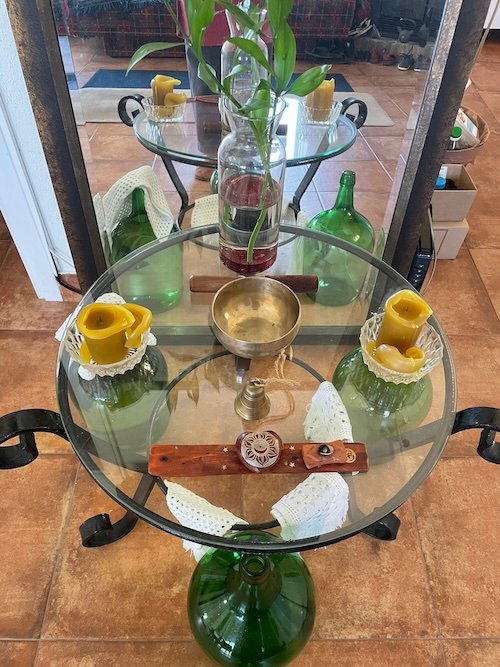
To Practice Gazing

If you’d like to do this, start by deciding how long you’re going to do the practice. (Start with 2-5 minutes if you’ve never done it before. A mere 20 minutes blows my head off in the best way possible.)

I prefer doing this in plenty of natural light, because when things get weird visually, sunlight is comforting.

With Two: sit or stand so that you can see each other’s eyes clearly, and far enough away that you both have ample personal space.
Alone: Stand or sit in front of a mirror that you don’t have to hold, close enough that you can see your eyes clearly.

Gaze into the eyes of the other or your own. You might be able to see both of the others’ eyes at once, or just see one eye at a time. Do your best to not get too concerned about this, as both situations are fine, including changing around what you’re looking at. This will settle itself out during each practice.

Allow yourself to blink naturally, and relax your eyes as much as possible while still looking at the other eye(s).

Stay here. Stay present. Notice what arrises.

The biggest challenge of this practice is, Can you stay here (present) and keep gazing through the discomfort?

Can you stay through what your body reads as confrontation (looking directly into someone’s eyes for a long period)? The reflex to fight, freeze or flee? The conflicted social feelings? The strained, nervous laughter? The ‘get me out of here!,’ even though all you’re doing is consensually looking at someone’s eyes? Maybe even your own?! It’s a bit nuts how confronting this is at first blush.

As you get past that stage, relax your physical eyes even as things get visually wacky. Things will go black and white, transparent, wavy, etc.. All kinds of visual ‘anomalies’ will happen. (One notable time, my friend’s face was replaced by a long series of other faces… men, women, children, young and old, modern and ancient… past lives? ancestors? my imagination? her imagination? I have no idea.) If you freak out at any of this and force your eyes back to ‘normal’ focus, that’s fine. Simply breathe, relax again and see if you can stay a little longer through the discomfort.

As you are able to, the payoffs are huge.

First, your capacity to be present for longer and longer periods will build.
More and more heartbeats will fully register in your entire being.

Welcome home.

Second, your conscious awareness of the wholeness that you are will deepen, become more and more subtle, more and more profound, more and more simple and whole.

Staying Through the Discomfort

Even if you don’t do Gazing, the practice of staying through the discomfort has served me immensely these past weeks. On some level, this has become my constant daily practice, my mantra of sorts, “Can I stay (fully present) through this discomfort?”

This offers it’s own soft wholeness. Not nearly as confronting. Gently allowing.

My suggestion, should you like to do it, is to practice staying lovingly present through discomfort, accepting whatever arrises within you as a welcome expression of who you are in the moment. If nothing else, you’re more present to who you are right now, and that is a beautiful place to be. It is where most healing starts, with the wholeness that we already are.

May that be Helpful,
Elena

Power of the Pause, Useful Pattern Interrupts

Iceberg from above and below the water

As adults, one of our biggest challenges, are the painful unconscious patterns that we run. On a daily basis, we can find ourselves in the middle of doing things that we really wish we weren’t. One handy thing to do is to pause and interrupt them right there in the middle.

Here are 2 simple ones I played with yesterday.

Pause When Waking Up

In the morning, when you’re waking up and your consciousness is dropping back into your body, what’s the first thing your mind does? If you’re like me, your mind leaps straight into planning what you’re going to do today.

Great.
Seems useful.

Except that yesterday morning, as I launched into that habit, I paused for a moment and checked in, “Why am I doing this? I’m not even fully awake yet!” I realized that I was planning my whole day without seeing how I was feeling first. I was making a whole list of decisions without knowing what I was ready for… I was planning my day with a sense of urgency, and no sense of self awareness.

Wow. Ok.
Then I realized that I railroad myself into tasks like this every morning. Goodness.

Why? What need am I filling here? And is there something better I can do to fill it?
(These are great questions to ask when working with any pattern, especially challenging addictions like blame/shame, smoking, etc. We do them for good reasons, so we need to understand what those are in order to fill the needs with something healthier)

An unconscious pattern unfolded for me… I realized I wasn’t feeling good in my body, which is true most mornings because I generally wake up feeling tired, and instead of laying there in the “ughhhhhh,” I start reaching for what I’m going to do today. That way I avoid focusing on how bad I feel. The need here is to feel better!

This was really helpful.
It allowed me to take a few minutes to stretch and breathe and improve my overall sense of wellbeing, so I started the day feeling great versus rushed.

So, the question for you is, what do you do as you’re waking up?
This is an excellent moment to pause, notice if you’re running any unconscious patterns that aren’t so helpful, and ask, “What’s the need here?”

Pause When Reaching For A Distraction

This is a big one for most of us. The first one got me thinking about patterns, and not long after a really obvious pattern popped up: distracting myself with food. Some people like to distract themselves with social media (I join them at night!). During the work day, I like to distract myself with snacks.

So the first time I got up from my desk to go get a little something, I paused and asked, “Why am I doing this? What need am I filling here?”

I realized, yet again, that I didn’t feel good. Eating or drinking something tasty was a way to feel better.
So then it was, ok, what are some ways I can feel better?
Well, what’s the source of the bad feeling? Am I bored? No. (If yes, how can I make this task more fun?)
Stressed by what I’m working on? No. (If yes, how can I bring some ease into this task?)
Am I upset, scared or otherwise emotionally uncomfortable? No. (If yes, how can I help myself calm down?)
Turns out, I really needed some water! LOL.
I’m sure it’s often one of the other reasons, so I’ll keep doing this today and see how it goes.

Pause Tips

In order to pause before we launch an unconscious pattern, we need to bring some conscious decision making into the mix. How to be conscious of something we’re not conscious of? Great question.

The usual way to do this is with visual cues like ribbons, sticky notes or notebooks.

If you want to play with pausing in the morning, put something next to your bed like a ribbon on your bedside lamp or a sticky note on the wall that you’ll see as you open your eyes. Use that to remind you to pause and check-in before you launch. Alternately, a notebook on your bedside table as a reminder has the added advantage that you can write down your reflections each morning, plus any dreams you want to record.

If you want to play with pausing before you reach for a distraction, put a ribbon on it: on your tea cup, the refrigerator, your phone, your cigarettes, etc.. Let the ribbon or sticky note remind you to pause and check-in. What do I need right now? Again, a notebook as reminder has the added function of providing a place to track the what’s happening overall. What tasks or situations or times of day inspire you to reach for distraction? What are the needs? What helps quench them? And as you see the patterns, how can you tweak your day to make tasks and rest more satisfying (so you’re not wanting to distract in the first place).

Ninja Level Bonus: Pause When Angry

This one needs little explanation, though it’s challenging to do! As you can imagine, when you’re feeling angry, you can pause in the middle of that and check-in: what am I needing here?

Anger can be really helpful, as it’s gives us a lot of powerful energy in the moment. Sometimes, that’s really useful, like when you need to get out of harms way. The rest of the time, we’re often reacting to some past hurt… hello unconscious painful pattern. Patterns that involve anger can be really destructive, especially if we direct that powerful energy at someone else or ourselves. This is a great time to do a pattern interrupt.

How to do this one? When you notice that you’re angry, it’s actually easier to hit pause via the body than the mind. There’s a simple thing you can do which is to start lengthening your exhale. As soon as you notice you’re angry (Congratulations! You’ve just gotten more conscious!), invite the next exhale to be a little longer and just notice the response. Keep inviting and noticing in this fairly passive way, and watch your nervous system calm down from whatever fight or flight response was triggered. This passive focus allows the body to calm down at it’s own speed, without feeling pressured, and works better for me than trying to force it.

This one is not so easy, and yet, it’s a great way to play with pausing painful patterns.

If you have any suggestions for this one, or you have a different way to gently interrupt your anger, I would love to know!

Have a wonderful day, and enjoy playing with the pause.,

Elena

Stopping Unconscious Behaviors in Their Tracks

Last month, a week after my partner left for the States, I was standing at the kitchen counter making lunch when my fingers landed on something sticky. “Gross!” Disgusted, my thoughts ran down their habitual rails, “Damn it, Benoit! Why don’t you ever clean the counter?! You don’t care about keeping the kitchen clean!” As I unstuck my fingers, a mortifying realization dawned, “Oh no! He’s been gone a week! This mess is mine!”

Cue guilt, shame… “God, why do I always blame him? He’s not even here! I can’t believe I’m so mean to him! I’m so unconscious! There must be a million things I’m not taking responsibility for! How am I ever going to fix this?!”

Continue reading →

Your Quiet Depth Under Your Distractions

If you’re in the mood to connect with yourself,
take a few quiet breaths, and let’s dive in…


I think about containers a lot, and while one of my ultimate explorations is, ‘what (kind of a container) am I?,’ I’ve just been sitting in the quiet noticing the impact of what I’m choosing to contain… what I’m inviting in, what I’m entertaining…
and how that distracts me from my ability to notice my deeper self, to notice what I am underneath all of that.

Simply, I’m sitting here noticing my daily thoughts…
and how they are a lot of static,
a lot of interference,
ultimately, just a lot of noise.

Continue reading →

When Pushing Through Isn’t The Answer

I was home recently, and a family friend and I started discussing how she gets tired quickly in situations that are stressful. She starts to get overwhelmed and then very, very sleepy.

While we’re both introverts in the sense that we need time alone to feel whole and resourced, her tiredness is beyond that. It’s very linked to stress, and it comes fast. It’s a trauma response, in that her existing emotional overwhelm is being triggered by the stressful situation. This pattern is very uncomfortable for her, and sometimes she gets so uncomfortable that it affects the entire group of people around her.

We were sitting in the living room, reflecting on it. “When you notice it’s happening and you feel the fear,” I said. She sighed, chiming in, completing my sentence with the obvious cultural trope, “…do it anyway.”

Continue reading →

Getting Comfortable with Our Emotions by Moving Our Bodies

Hello Beautiful Souls,

There are several steps to becoming comfortable with our uncomfortable emotions – and many ways to go about it!

First, we need to feel safe enough to even start. If we’re feeling really threatened, it’s hard to want to do anything other than defend or protect. So it you’re interested in this topic, congratulations, you’re already in a good place – you feel safe enough to even consider this! Bravo!

Continue reading →

Rock Your Body: 5min Guided Meditation

(5min47sec) This simple movement practice can be done standing or sitting. Once you learn the basic meditation, you can practice it for as long or short a time as you like. This is the same concept as Where’s My Center, only simpler, and they can be used interchangeably as basic movement practices.

Note that you are welcome to download and share this audio file as many times as you like, provided you do so in it’s entirety, and it is used for personal or educational uses only (no commercial uses).

Practice Giving and Receiving

Guided Meditation Recording (8m10s)

As social animals, giving and receiving are a daily part of life. We need each other for mental, emotional and physical support – on a daily basis, and those needs can sometimes be challenging to have and support. Often times we develop habits where one is easier than the other. Many of us are better at giving and others are better at receiving. It’s not so often that we feel equally comfortable with both. And that can change depending on the people we’re with and situations we’re in. Sometimes it just feels easier to do one and not the other.

Continue reading →